



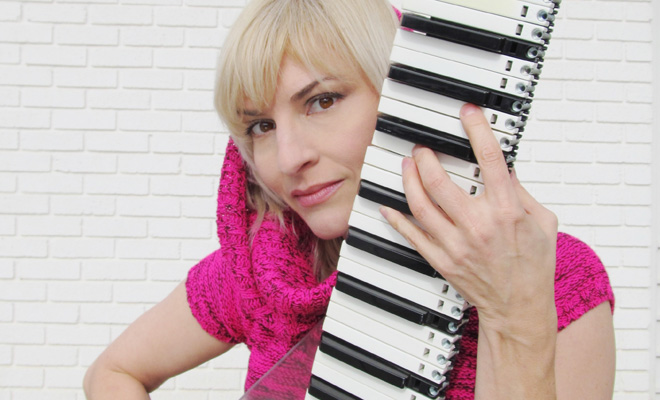
Are you ready to be transported to new dimensions of sound? If so, you won’t want to miss this groundbreaking interview with revolutionary artist Elaine Walker. With more than three decades of exploring microtonal music, her cutting-edge album, ‘Four-Momentum,’ appears to be ahead of this era!
1 — For those unfamiliar with your work, how would you describe the overall style of Elaine Walker?
Space-math-Disco is what I’ve been feeling lately. I’ll always be stuck in the 80s somewhat. But these last few years, I’ve been reconnecting with my late 70s Disco roots. Back when I was a kid at the roller rink and first heard those sparkles in the air, I wondered, “What are those SOUNDS, and are they made by magic?!” A couple of years later, I saw MTV, and that’s when I realized the sounds came from synthesizers, and I HAD to have one. I feel like my childhood had a great soundtrack, and I try to spread that same happiness through my synths, but I pretend the 70s and 80s made a comeback in the year 3000. By now, we’re making cities on Mars, we’ve become transhumans, and we’ve befriended aliens. I envision a future where there are sparkles in the air by default.
2 — What synth gear and equipment did you draw on to craft your melodies?
That’s a great question because it has evolved. Up until 10 years ago, I exclusively used hardware synths. I had a Roland JX3P, Yamaha DX7, Ensonic ESQ, Korg Wavestation, Kurzweil K2000, and my crazy vintage Moog Sonic Six. Whatever synths should sound like–fat, gritty, juicy–hardware synths sound MORE of. I was the last holdout! But I finally discovered the convenience and, quite frankly–magic–of software synths. I use a lot of Arturia synths and others, but my favorite is Zebra by u-he. I only write microtonal/xenharmonic music, by the way, and it was always a clunky process getting my hardware synths micro-tuned on those little screens, much less in tune with each other. Finding software synths that can be micro-tuned was also tricky at first, but it’s almost a non-issue now. In one fell swoop, I throw MTS-ESP Mini by oddsound onto a blank track, pick a tuning, and boom, every synth on every track is micro-tuned. Anyone can give microtuning a try nowadays.
3 — What kind of synth sounds in particular help set the mood of your new reimagined album ‘Four-Momentum’?
I’ve been listening to Jean Michelle Jarre and classic sci-fi movie soundtracks. So that’s everything from the pure, clean waveforms to lush, phasing strings. I like to use contrasting sounds like that to give the music depth. Also, it only sounds complete with laser gun sounds and slidey, sweepy effects. It’s freeing not worrying about playing everything live. Back in the days of ZIA shows, we played all the synth parts live, which is the opposite of most bands. We should have gotten more credit for that! We triggered the parts with sticks on Drum Kats and walls of circuit boards, and I played my Planetar. So the audience could easily see what we were playing. If we had a backing track, it was only for drums and/or boring synth pads no one cared to play. I always had that in mind when composing–who might play what. But now anything goes!
4 — This album could totally soundtrack something legit on the big screen. What movie do you think it suits best?
Oh gosh. Lorenz Force was inspired by Bladerunner. Skate Space was inspired by Xanadu. Mobius might fit into a Flash Gordon movie. Basically, any quality sci-fi! Once, at the Playboy Mansion (don’t ask… actually, it was a 2001 Space Odyssey event!), I gave James Cameron a CD of my music and said, “Here’s some microtonal music for your sci-fi movies. I think microtonal music would suit sci-fi really well.” He held the CD and said thoughtfully, “Microtonal music, eh?” But then suddenly, he was torn away by one of his handlers to take him somewhere else he needed to go. I wonder if he ever listened to it. I have better stuff now, 22 years later.
5 — What new techniques did you experiment with for this fresh version of ‘Four-Momentum’?
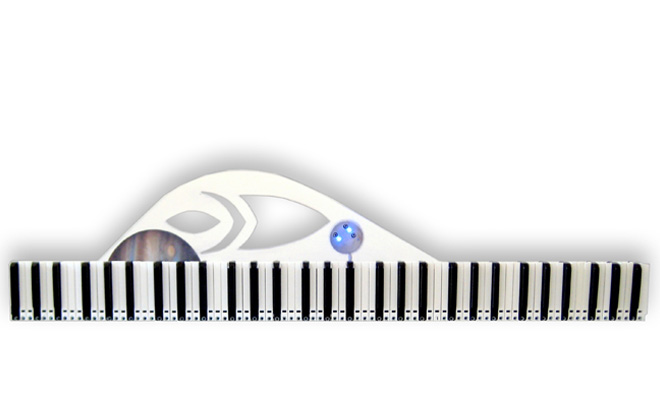
I’m not sure about new techniques, but I did use some micro-tunings I had yet to try, such as 14, 15, and 20 notes per octave. Almost all music in the world is 12 notes per octave, like pianos and guitars. My favorite tuning is 10 notes per octave. It’s incredibly otherworldly and exotic and makes a cute keyboard. Imagine white/white/black/white/white/black/white/white/black/white, so there are three white notes in a row where it repeats. 20 is just a doubling of 10, so that was fun to finally try. 14 was a little rough. But 15 has so many good chords to use. I can’t believe I never used 15 before! Every tuning has a different “flavor” and different limitations. It’s both fun and infuriating. Anyone can try it, and just use your ear. Don’t worry about the music theory that doesn’t exist yet!
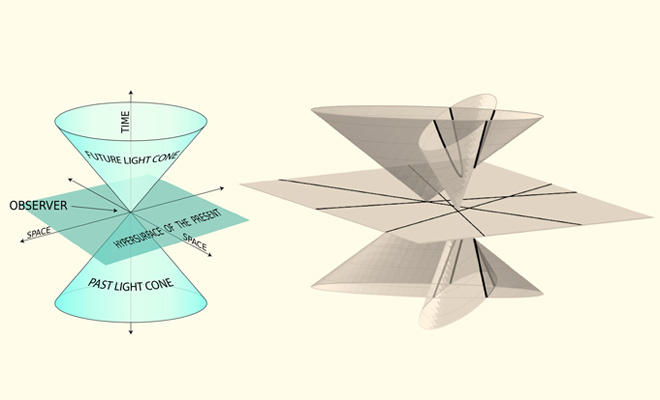
6 — Why is it titled as ‘Four-Momentum’?
A few years ago, I discovered, thanks to a mathematician friend I had just made, that I could do math in my head by visualizing shapes and surfaces, and we have a few published papers together now (see ziaspace.com/math). During the time I was writing this music, we were looking at hyperbolically rotated cones and discovering similarities with four-momentum space-time ideas. All we were doing was letting rectangles ride around on 4 random lines. Their centers were tracing out hyperbolas, which developed into what looks like skewed space-time “light cones” intermingling. When writing music, my head is often deep in some weird math universe like that. Thus, the math nerd titles.
7 — Out of all the changes in your artistic career, which would you highlight as the most poignant evolution?
It was early on. There was a good long while in the 80s when I wanted to be an electronic music Pop star. I messed around with synthesizers, wires, and tape recorders, thinking it was all about the music, the technology, and what eyeliner we would wear. What profoundly changed the course of my music was when I was introduced to microtonality in 1990 by Dr. Boulanger at Berklee College of Music. My entire attitude about life changed one year later when I graduated and had a grand epiphany about life, the Universe, and everything. I suddenly (literally one afternoon when I got onto the internet for the first time) realized I was interested in so many other things––futuristic technology, the idea of humans venturing out into space (especially to Mars, but I also envisioned people frozen in pods going to deep space), with smart chips in our heads of course. I suddenly knew I would use any gifts I had to promote a positive outlook for the longevity of humanity.
8 — Would you be open to a collaboration involving vocalists?
Collaborations are super hard because the music is microtonal. But someone with a good ear could sing along to the tracks. I’d still love to sing, but as I gain more responsibilities in life, the first thing to go is my desire to vocalize (talking, singing, just vocalizing in general). That might be an autistic trait. Plus, I enjoy listening to instrumentals more than vocal music myself. I realized that was ironic, so I decided to give the world more instrumental music. Anyway, I’d collaborate with a vocalist if it was someone really sharp and creative, like Grimes. Not sure who else.
9 — Do you have any plans to incorporate live synths at your shows?
As I described earlier, my ZIA shows were always all-live synths. It was a team effort to haul all the synths and plug in the giant “umbilical chord” we called it, which had the precise lengths of power and MIDI cables hanging off at the right places. I’d toss the colossal thing across the back of the stage, and then my bandmates would furiously plug it all into the Drum Kats. I’d be at the back of the big synth rack with my flashlight headband. We were a well-oiled machine for most of those years. If we had any technical difficulties, it felt really exciting to me. I’d imagine, “We’re on the space station, and I have 30 seconds to find which wire shook loose, or we’ll all suffocate.” I’m not sure I have the right kind of energy for all of that anymore!
10 — Is there anything new in the works we should know about?
I have a Patreon that I started during the early days of Covid. I’ve mainly posted new music there. I show my tracks in Ableton and sometimes perform parts on my keyboards. I’ve shown the process of rearranging the keys for microtonal keyboards, giving my little daughter homeschooled math lessons, and giving book updates. But I also want to show the math I do and explain it in normal English, with illustrations. I have lots of other ideas. So what’s in the works is that I’m gearing up to use this new camera stand and lapel mic that my family got me for Christmas and getting in the mood to vocalize on Patreon! All funds I make on Patreon go toward my keyboard inventions. Patents are in the works.
CONNECT WITH ELAINE WALKER!

Hi, I’m Erick Ycaza — a music blogger with a BA in Advertising & Graphic Design. I created this blog to keep you updated with daily music news. Surprisingly, I’ve been writing about music since 2007. If you’re an artist and would like to be featured, feel free to reach out: info@electrowow.net

