


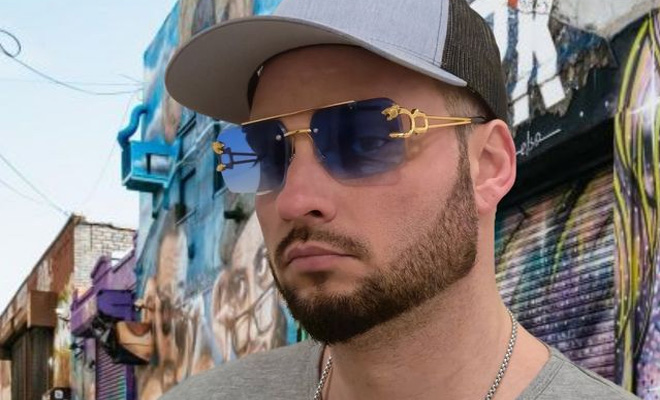
XCENTRiC‘s journey is anything but ordinary. The DJ-turned-producer traded his electrician’s tools for turntables at 18, and now he’s carving out a lane where Hip-Hop grit meets underground House and Tech House, proving that sometimes the most “eccentric” path leads exactly where you need to be.
1. Do you remember the moment music really hit you?
Before I even had a mixer, I was making playlists for family parties—reading the room and picking songs that made people move. But it goes back even further. I’ve been obsessed with sound since I was a baby. I’d crawl toward the stereo, fixated on the lights and the vibration.
That early obsession never left me. His mom saw it early. He was called eccentric because of how different his selection was—he’d pick tracks that shouldn’t work together, but somehow they just did. That name stuck. Later, it became my identity.
2. How did that early love for music evolve into DJing?
As a teenager, I was deep in the underground. Pop-up raves, warehouse parties, drum and bass, breakbeats—it was chaos, and I loved it. I absorbed everything from jungle to trance to house. But it wasn’t just electronic music. Hip-hop and rap were huge for me, too. The bounce, the grit, the storytelling—it hit something in me. I wasn’t just listening to tracks—I was studying them.

3. Do you remember your first big step into music as a career?
Yeah—18 years old. I landed my first club residency and made the call to quit my full-time job as an electrician. I was standing on a job site one day and just knew: “I don’t belong here.” Within a week, I was booked. No fallback plan, just music. From that moment on, I was all in.
I didn’t fully quit the trade at that moment, though. I left that job to pursue my dream as a DJ, but over the years, I still did electrical work on the side just to fill in time, when honestly, I should have been producing instead. Looking back, it’s wild—but it shaped how serious I eventually got.
4. You were DJing before you were releasing tracks. What flipped the switch for you as a producer?
For a while, I thought DJing was the whole game. I knew how to produce, but I didn’t take it seriously. I was doing well as a DJ, but something was missing. Around 2021, I locked in and said: If I want to really make my mark, I need to be creating the music that reflects both sides of me.
I started off experimenting, thinking people wanted to hear certain types of EDM. I was making Melodic Techno and Progressive House styles that weren’t really me. It took about a year for me to realize I needed to be myself.
That’s when I found my sound: urban-infused Tech House and Minimal Tech House. The bounce of Hip-Hop with the energy of the underground.
5. How would you describe that sound now?
It’s raw, catchy, and gritty. Unique synths, unexpected flips, and grooves that hit. It’s dancefloor-driven but still has soul. I bring in Hip-Hop influence because it’s what I like—I connect with it. It’s in the rhythm, the swing, the mood. My style isn’t laid back.
It’s aggressive in the best way. Every track has that “hyped” feel to it—something you can move to with purpose.
6. How long did it take to get that level of sound dialed in?
Man… years. I was already mixing and playing out, but producing at a serious level meant locking myself in the studio for nights on end. Truly learning the gear properly, understanding sound design, A/B testing everything. I became obsessed. I wanted to compete with the
best—and still sound like me. No templates. No formula.
7. How do you approach live sets now that you’re producing your own material?
Everything changed. I’m not just DJing—I’m performing my own music, dropping unreleased tracks, and fully preparing sets. People are coming to hear my sound and see me, rather than just going to a club to hear a “DJ” play like a jukebox.
I now play shows where people come up mid-set asking what track that was, letting them know it’s mine, and it’s not even out yet. I love it. That’s the best feeling. I want people to hear something they’ve never heard before, but still feel like it’s exactly what they needed.

8. What role do your labels play in your journey?
I founded XCENTRiC RECORDS® to give myself and other artists a real platform—somewhere we could push boundaries without needing approval from gatekeepers. It’s for music that doesn’t fit in a box. I’m also signed to Droptone Records™, which supports my own growth and sound as an artist.
They aren’t pushy with me, and I’m not tied to them the way most labels lock in artists. I’m able to collaborate with other labels freely while still being backed by Droptone. It’s like having a team that believes in me and wants to see me win. Between both labels, I’ve been able to stay independent and still make serious moves.
9. What’s the vision moving forward?
Keep growing. Keep innovating. I’ve got tracks dropping that level up the sound even more. I’m building visual content, refining the brand, and constantly creating. The fans are locked in, and I’ve got more to give. This isn’t just a career—it’s a calling. It’s a feeling.
10. Final words?
This isn’t a phase. This is a movement. And it’s only the beginning—and never the end.
CONNECT WITH XCENTRiC
YouTube | Facebook | Instagram
Hi, I’m Erick Ycaza — a music blogger with a BA in Advertising & Graphic Design. I created this blog to keep you updated with daily music news. Surprisingly, I’ve been writing about music since 2007. If you’re an artist and would like to be featured, feel free to reach out: info@electrowow.net

