



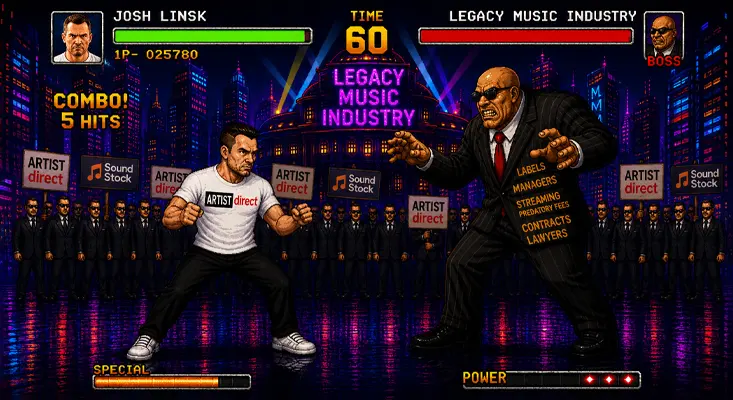
For decades, the music business operated through a closed ecosystem controlled by major labels, gatekeepers, licensing conglomerates, and legacy infrastructure that often moved at a painfully slow pace compared to technology itself. The industry became dominated by massive corporations built around ownership, control, exclusivity, and complex licensing structures that often left independent creators feeling trapped in a machine that benefited executives more than artists.
But a new era has arrived, and entrepreneurs like Josh Linsk are positioning themselves directly in the middle of one of the most important shifts the music world has seen in generations.
The Rise of AI-Powered Platforms
At the center of that shift is Sound Stock, an AI-powered platform built around the idea that music creation, licensing, sound effects, loops, and creator tools no longer need to be controlled by the traditional gatekeepers who dominated the industry for decades. While legacy companies continue operating under bloated systems created for an entirely different era, platforms driven by automation, AI, scalable infrastructure, and creator-first thinking are beginning to reshape what the future of music actually looks like.
The old music business depended on scarcity. The new music business depends on accessibility, speed, discovery, and innovation.
That is where the battle lines are being drawn.
Evolving Beyond Static Catalogs
Companies like Epidemic Sound helped prove there was massive demand for subscription-based music licensing for creators, but the next phase of the industry is no longer just about licensing libraries. It is about generation, customization, personalization, scalability, and AI-driven creation itself. The market is evolving from static catalogs toward intelligent systems capable of producing content at enormous scale while dramatically lowering operational costs.
At the same time, companies like Splice transformed how producers access samples and loops, helping redefine modern music production workflows. Venture capital poured into platforms built around creator ecosystems because investors recognized that the future of music would not revolve around traditional label infrastructure alone. The industry was becoming software-driven.
But even with these innovations, many major players still operate with centralized systems, expensive overhead, and structures rooted in the past.
That is where entrepreneurs like Josh Linsk see opportunity.
Dismantling the Gatekeeper Model
Sound Stock represents something larger than simply another royalty-free platform. It reflects a broader movement toward dismantling the inefficiencies of the legacy music industry itself. AI-generated music, AI sound effects, browser-based creation tools, instant search systems, scalable libraries, and creator accessibility all point toward a future where musicians, filmmakers, YouTubers, game developers, podcasters, and content creators no longer need permission from the old guard to create professional media.
The economy is changing rapidly.
For years, traditional licensing companies relied on scarcity, exclusivity, and complicated pricing structures to justify massive recurring fees. But AI systems dramatically alter the equation. Once generation systems become powerful enough to create massive libraries at near-infinite scale, the leverage begins shifting away from the legacy companies that built their dominance around ownership of static catalogs.
This is why the rise of AI in music is causing so much tension inside the traditional industry.
The legacy players understand what is happening.
The barriers are collapsing.
The old model required giant teams, expensive production cycles, licensing negotiations, publishing entanglements, and massive operational overhead. New systems increasingly require engineering talent, automation pipelines, AI infrastructure, and scalable distribution. The power dynamic changes completely when software can suddenly accomplish tasks that once required entire departments.
Media, Authority, and the Battle for Attention
At the same time, Josh Linsk’s expansion into editorial media through ArtistDirect and MusicNews.com signals another important part of the future battle: ownership of audience attention itself.
ArtistDirect carries enormous legacy recognition in the music world, and its modern relaunch represents more than nostalgia. It represents an attempt to rebuild a music media ecosystem for the modern internet era — one driven by SEO, large-scale editorial systems, artist discovery, search traffic, and direct creator engagement rather than the traditional magazine gatekeeping structures that once controlled music journalism.
Meanwhile, MusicNews represents an even bigger symbolic statement.
A domain like MusicNews.com immediately communicates authority, scale, and ambition. In an era where attention is fragmented across platforms, social feeds, algorithms, and AI systems, premium digital media brands still carry enormous strategic value. The future music ecosystem will not simply belong to whoever owns catalogs. It will belong to whoever controls discovery, distribution, conversation, and creator ecosystems simultaneously.
That is where the real war is unfolding.
The Future: Startups vs. Dinosaurs
On one side sits the legacy music industry — giant corporations built for the twentieth century, operating with enormous overhead, rigid structures, slow adaptation cycles, and business models dependent on maintaining control over intellectual property pipelines.
On the other side are technology-driven builders who move like startups rather than institutions.
The new generation understands something the old industry often ignored: creators want speed, simplicity, affordability, transparency, and direct access to tools.
They do not want endless gatekeepers.
They do not want complicated licensing structures.
They do not want to wait months for approvals.
And increasingly, they do not need to.
AI, automation, scalable generation systems, and direct-to-creator platforms are beginning to erode the dominance that the traditional industry once considered untouchable. What once looked impossible now feels inevitable. In the same way streaming disrupted physical distribution, AI and creator-first infrastructure may ultimately disrupt the licensing and production industries themselves.
Josh Linsk’s growing ecosystem across Sound Stock, ArtistDirect, and MusicNews.com reflects a broader belief that the future of music will belong to platforms willing to innovate aggressively while the legacy industry struggles to adapt.
The dinosaurs still have size.
But innovation moves faster than dinosaurs ever could.

Hi, I’m Erick Ycaza — a music blogger with a BA in Advertising & Graphic Design. I created this blog to keep you updated with daily music news. Surprisingly, I’ve been writing about music since 2007. If you’re an artist and would like to be featured, feel free to reach out: info@electrowow.net